|
|
| Improvisation for the March Equinox 2014 | 2014 | In this improvised track I utilize micro-tonal tuning and my idea to create music that is possible only through the tight integration between human and machine. The first half is sustained and the second half is rhythmic. |
| Mysterious Bells (improvisation) | 2010 | Individual bell tones occur seemingly at random but coalesce as this work progresses. I put this track together to try out custom logic circuits that I had just built. |
| March Improv (improvisation) | 2010 | After completing some new voltage quantizers and Mega Percussive Synthesizer modules, I created this punchy track. |
| Filterplay (improvisation) | 2009 | This work is played entirely with filter feedback rather than with oscillators. The result is a sound that has a somewhat "organic" quality to it. |
| February Snowflakcs (improvisation) | 2009 | This is a slow and introspective work. This is a large file -- the work is 26 minutes long. |
| My Dance Card (improvisation) | 2009 | I wanted to try building up loops that had little semblance of a rhythmic groove and slowly turn them into something interesting. It occured to me that this is the way I dance. I have no clue at first and then I kind of get the hang of it. |
| Correlli -- Christmas Concerto -- m.6 Allegro | 1978 | Switched-on music was "in" and the Aries Synth works very well for such music. |
| Bach -- Concerto in d-minor -- m.3 Allegro | 1977/2004 | Re-recorded the lead part in 2004 for this mix. In the old days, I used foot pedals to control volume and timbre. I used a touch-sensitive keyboard to control the Aries synth in this mix. |
| "Flute" Improvisation | 1985 | A pitch track and the pitch-to-cv interface keeps things together without the need for click tracks or scores. |
| Improvisation with Synthesized Percussion | 1982 | Included here just for fun! I guess I was in an intense mood when I recorded this. |
| Sounds for Multi-Media - part 1 | 1978 | This is an aleatoric/freeform work that showcases some of the Aries' vintage sounds. I had this idea of creating electronic sounds to accompany a multi-media work. The multi-media presentation never happened and neither did a "part 2". |
|
Music making on the Aries Synth
My music-making on the Aries focuses on the following areas: 1) classical transcriptions ("Switched-on" music) 2) original compositions 3) experimental/freeform To do transcriptions demands traditional keyboard skills and the ability to imagine sounds in one's head. Since vintage synths don't have computer memories, a musical part must be recorded with a particular sound (patch) before moving on to the next part. Thus the tasks of performing, patching, orchestrating, and experimenting all happen concurrently! One of the challenges of improvisatory music is to work spontaneously while layering music on multi-tracks. How does one liberate oneself from mechanical "click tracks" and pre-determined progressions while keeping everything "together" on multiple tape passes? One solution was to record a "pitch track" that could, in turn, drive the pitch-to-voltage interface. This allows multiple tracks to be built up that are harmonically related to each other. The "Multi-Media" improvisation is essentially a non-keyboard work. The beautiful progressions at the end were all produced with slowly triggered sample-and-hold module. |
About Kevin's Custom Modular Synth
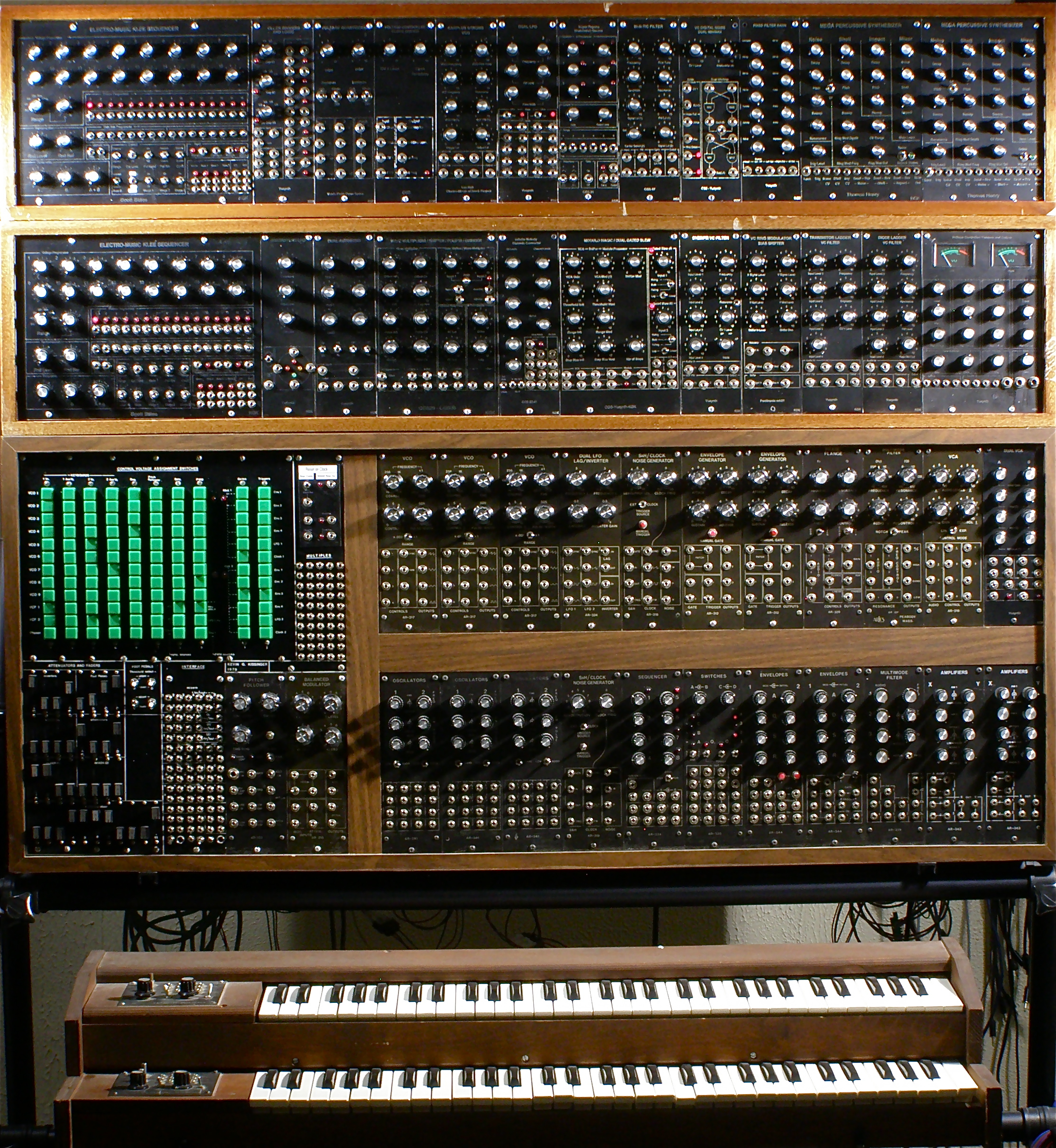
This synthesizer began in 1976 as an Aries synthesizer. I decided to expand this synthesizer in 2010 and it has more than doubled since then. This synthesizer began as an instrument to be used with multi-track recording equipment to make studio-created music. I have added new modules that have transformed the synthesizer into a real-time composition/improvisation tool. Thus, I explored real-time music making with this synthesizer and an external loop-station (Looperlative LP1). To support real-time usage, the synthesizer has some interesting features: . Klee Sequencers to enable thousands of variations based on a single sequence of voltage steps. . Mega Percussive Synth modules to create analog percussion sounds and free up other modules for other purposes. . MIDI-to-CV converter, clock dividers, and gate/trigger logic to enable spontaneous interaction with the clock signals from the performer. |
|
Analog Synthesizers then and now
The use of electronically-generated sounds for musical purposes started in the 1920s. The earliest electronic composers assembled sounds (bloops and bleeps!) on tape and painstakingly spliced pieces of tape together to "assemble" music. The results of this electronic medium was music that was largely experimental in nature lacking expressive qualities that are associated with traditional music performance. A major breakthrough was the development of "voltage control" that allowed the parameters of the sounds to be controlled with voltages rather than by manually turning knobs on filters or oscillators. The Moog (rhymes with "rogue") synthesizers integrated voltage-control throughout and generated interest from traditional musicians. Analog voltage-controlled synthesizers "ruled" the 1970s! The Moog synthesizer was so well-known that people tended to call all synthesizers "Moogs". Like most synthesists from that time, I could only dream of getting my hands on a Moog Modular synth! I was always amused when people would point to my Aries synth and say, "There's Kevin's Moog". Analog synths have limitations. They can only play one or two notes at a time. Back then, one could not store and recall sounds (patches) from a computer memory. A vintage analog synth has a steep learning curve because one has to learn the signal paths within the synthesizer before one can get a 'squeak' out of it. By the mid 1980s, digital synthesizers, with their polyphonic capabilites, stored settings, and bright bouyant sounds were dominating the scene. Indeed, analog synths were gathering some dust in the 1980s. In recent years, musicians have discovered that analog synths have unique power and spontaneity and fill a void in what are otherwise digital studios. With the current affordability of multi-track equipment, analog synthesizers can reach potentials that were out of reach in days gone by. Today more analog synthesizer manufacturers exist than ever before! |
Specifications
3 AR-317 Voltage Controlled (VC) Oscillators
3 AR-341 Dual VC Oscillators 2 AR-312 Envelope Generators 2 AR-344 Dual VC Envelope Generators 1 AR-316 VC Amplifier 2 AR-343 Dual VC Amplifiers 1 AR-327 VC Multimode Filter 1 AR-339 VC Multimode Filter 1 AR-329 VC Phaser/Flanger 1 AR-315 Balanced Modulator 1 AR-334 8x2 Sequencer 1 AR-335 Switches 2 AR-318 Sample/Hold/Clock/Noise Generator 1 AR-324 Dual LFO/Lag/Inverter 2 AR-313 61-note keyboards (2-note polyphonic) 1 AR-333 Pitch-to-Voltage converter 1 (KGK) 11-channel mixer 3 (KGK) 4-channel mixers 4 (KGK) floating attenuators 4 (KGK) Inverters 4 (KGK) Foot pedal attenuator/controllers 1 Paia MIDI to Voltage converter 2 Thomas Henry Mega Percussive Synthesizers*
1 Yusynth Clock Dividers and Logic*
2 Klee Sequencers* 2 MFOS Voltage Quantizers* 1 CGS Voltage Controlled Divider* 1 CGS Super Psycho Modulation Source* 1 Les Hall V.C. Karplus Strong Oscillator* 1 CGS Bi-N-Tic (switched capacitor) filter* 1 Yusynth Fixed Filter Bank* 1 Fonitronic mh31 VC Ring Modulator* 1 CGS Sawtooth Shifter/Animator* 1 CGS Wave Folder/Shaper/Grinder* 1 (KGK) Gain/Level Shifter* 1 Yusynth Quad VC Panners and Stereo Output* 1 Yusynth Diode-Ladder filter** 1 Yusynth Transistor-Ladder filter** 1 Yusynth Steiner filter** 1 Yusynth VC Quadrature LFO** 1 CGS Modulo Magic* 1 Yusynth Voltage-Controlled Amplifier** 1 Yusynth Dual-Gated Slew** 2 Yusynth V.C. Low Frequency Oscillators** 1 Yusynth Dual Autobend** 1 Yusynth Dual Voltage-Controlled Amplifiers** 1 CGS 1/nfinite Melody*** 1 CGS Diatonic Converter*** 1 CGS Digital Noise Generator*** 1 Yusynth Dual Min/Max*** 1 Delay Reset until Next Clock (KGK)+ 1 (KGK) matrix patch unit (120 patch points) 1 KGK 240-p Quad Quantized S/H with mini-sequencer++ 1 KGK 241 Quad Quantized S/H with mini-sequencer++ 1 KGK 251 Quad Voltage-Controlled ADDSR E/G++ 1 KGK 252 8 channel Voltage-Shifter/Attenuators++ 82 patch cords * - modules added in 2010 ** - modules added in 2011 *** - modules added in 2012 + modules added in 2013 ++ modules added since 2024 |